The cabin starts to descend and one ear will not “pop.” Or you are on a dive and a sharp pressure builds behind the eardrum before you can equalize. Moments later the ear feels full, hearing drops, and the question becomes whether this is a cold, an infection, or something the flight itself did.
That pattern is often ear barotrauma — pressure strain on the middle ear when the Eustachian tube cannot keep up. This article is what I usually walk through with travelers and divers in clinic: the mechanism, why planes and dives are classic triggers, how symptoms differ from acute otitis media and outer-ear problems, what helps in the moment, and when an in-person exam is wiser than waiting. It is guidance, not a remote diagnosis. Telemedicine can help with triage; looking at the eardrum still needs to be in person when the picture is unclear.
What ear barotrauma is
The middle ear is an air-filled space behind the eardrum. It stays balanced with the outside world through the Eustachian tube, which opens briefly when you swallow, yawn, or deliberately equalize. When outside pressure changes faster than that tube can match — ascent or descent in flight, a dive, even a fast elevator — a pressure differential forms across the eardrum.
That differential stretches or stresses the drum and the mucosa of the middle ear. Fluid can appear behind an intact drum; in more forceful episodes there may be a small bleed in the middle-ear space or, less often, a tear in the eardrum itself. None of that is, by itself, an infection. It is a mechanical and mucosal response to pressure. Infection can follow later if fluid stays and inflammation persists, but the initial event is barotrauma.
I use the travel or dive story as a strong clue, then confirm with otoscopy. A phone description of “blocked ear after landing” is not enough to sort pressure injury from acute otitis media or from outer-ear irritation.
Why planes and dives trigger it
In commercial flight, the cabin pressure change is steeper on descent than many people expect. As the plane comes down, outside pressure rises relative to a middle ear that has not equalized, and the eardrum is pushed inward. Ascents can also bother some travelers, but descent is the classic complaint I hear. Congestion from a cold, allergy flare, sinus inflammation, or recent upper-airway infection makes the Eustachian tube harder to open — so the same flight that was fine last month becomes painful this month.
Diving compresses gas spaces as depth increases. If you descend without equalizing, middle-ear pressure lags behind the water pressure around you. Forceful or late equalization, or diving with a blocked nose, raises the risk of barotrauma. Ascending with a blocked ear is a different problem again and is a reason to abort a dive rather than push through pain.
I advise patients with an active cold, fever, or clearly blocked nose to postpone nonessential flying when they can, and to stay out of the water until ventilation feels normal. That is risk reduction, not a guarantee that a clear nose means zero risk — and it is not a substitute for dive-medicine clearance when someone has had repeated or severe ear barotrauma underwater.
Typical symptoms versus infection and outer-ear problems
Barotrauma usually announces itself with fullness, a deep ache or sharp pain timed to altitude or depth change, muffled hearing, and sometimes popping, crackling, or tinnitus on that side. Dizziness can occur but is less typical of mild middle-ear barotrauma alone; when vertigo is prominent, I want a careful exam rather than a wait-and-see approach. If the eardrum tears, there may be sudden discharge and a change in pain — that still deserves evaluation.
Acute otitis media is an infection of the middle ear, often after a respiratory illness, with pain that is not necessarily tied to a flight or dive. Fever and a more “infectious” course are more suggestive of AOM, though pressure injury and infection can coexist or follow each other. Outer-ear infection (otitis externa) hurts when the pinna is tugged or the canal is touched; itching and canal swelling dominate, and the trigger is more often water exposure in the canal than cabin altitude.
A companion piece on ear pain after flying will focus more on post-flight symptom triage. Here the point is the mechanism: pressure differential, Eustachian tube failure, and what that looks like on exam. Overlap is real — which is why I examine the canal and the drum before labeling the problem from a search result.
What helps during a flight or dive
Equalization is the practical core. On a plane, start early on descent: swallow, sip water, yawn, or chew gum if that helps you open the tube. The Toynbee maneuver — swallow while pinching the nose gently closed — works for many people. A careful Valsalva — pinch the nose and blow gently as if clearing the ears, without forcing — can help if done early and without pain. Stopping when it hurts matters; aggressive blowing against a blocked tube can worsen injury.
For infants and young children, feeding or a pacifier during descent often helps more than asking them to “pop” on command. For divers, equalize early and often on the way down; never descend through sharp ear pain. If equalization fails, ascend a little, retry gently, and abort the dive if the ear will not clear.
Over-the-counter oral or nasal decongestants are sometimes discussed for travelers with known congestion. They are not a prescription from this article, they are not appropriate for everyone (blood pressure, heart disease, pregnancy, interactions, and age all matter), and they do not replace a clear decision about whether you should fly or dive at all with an active upper-respiratory infection. If you use any medication for travel, follow the label or a clinician who knows your history — do not invent a dosing plan from a blog.
After a painful flight or a failed equalization underwater, I prefer rest for the ear, avoiding further pressure challenges, and keeping water out of the canal if there is any suspicion of perforation, until someone has looked at the drum.
What we do in clinic after the fact
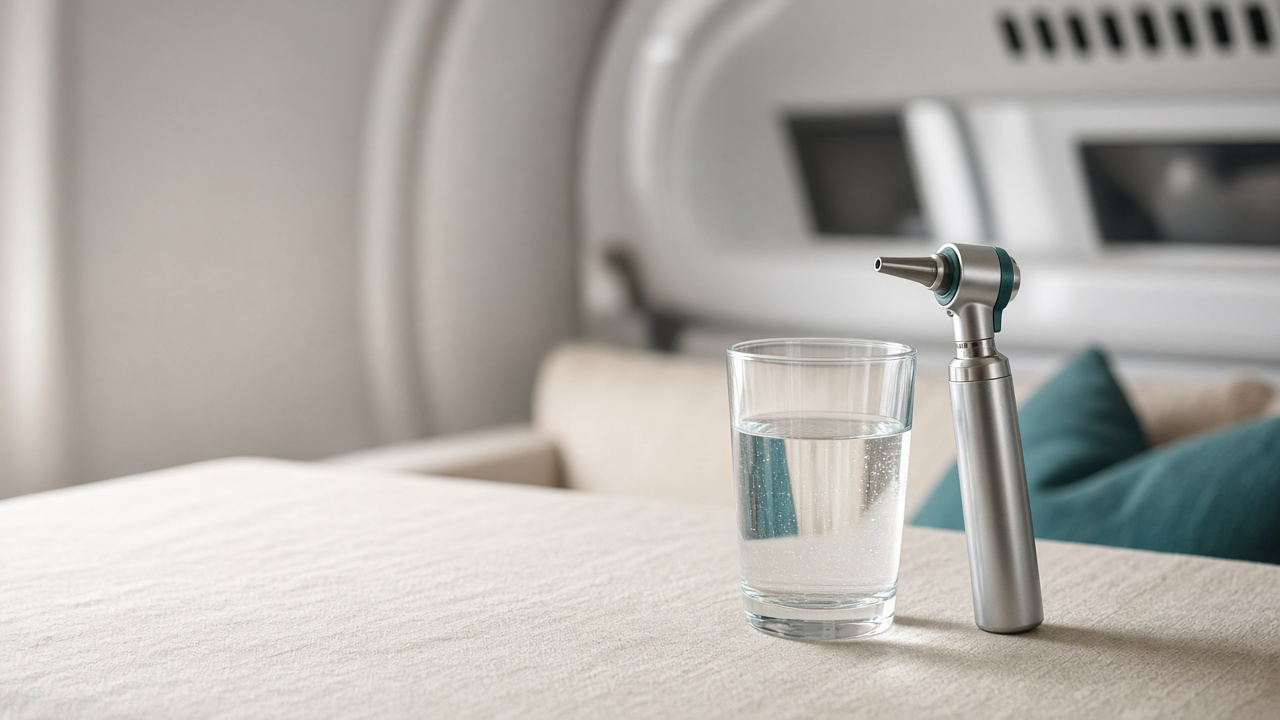
The visit starts with the story — timing relative to ascent, descent, or dive depth — then a careful look at the ear canal and eardrum with an otoscope or microscope. I want to see whether the drum is retracted, injected, has fluid or blood behind it, is intact, or shows a perforation. A focused nose and nasopharynx exam often belongs in the same visit when congestion was part of the trigger.
When hearing loss or asymmetry worries the patient, I may add bedside checks or audiometry depending on severity and how long symptoms have lasted. Management depends on what I see: observation and symptom control for mild findings; keeping the ear dry and arranging follow-up if there is a perforation; treating a secondary infection only when the exam and course support that; and a clear plan for when flying or diving can resume. Return-to-diving advice is individualized — a healed exam and stable hearing matter more than a fixed number of days from a webpage.
Telemedicine helps me decide urgency and whether red-flag symptoms are present. It does not replace seeing the eardrum when the next step hinges on that view.
Red flags and when to seek care
Seek prompt in-person care — emergency services if ENT access is not immediate — for sudden significant hearing loss, persistent spinning vertigo, facial weakness, severe headache or neck stiffness with ear symptoms, heavy or bloody discharge after trauma, or pain and hearing loss that worsen instead of plateauing after the flight or dive. These are not the everyday “blocked ear after landing,” and waiting overnight is the wrong trade when they appear.
Also come sooner if you are a diver with repeated failed equalization or barotrauma, if you have had prior ear surgery, if you have only one reliably hearing ear, or if muffled hearing and fullness are still clear several days after travel without improvement. Adults with diabetes or immune suppression should use a lower threshold for being seen the same day when discharge or severe pain appears.
For many mild, improving episodes without red flags, a same-day or next-day ENT or primary-care visit is the right lane — especially before the next long flight or before returning to the water. Telemedicine can triage timing for expats sorting the local system; once we need to inspect the drum or clear someone for diving again, the appointment needs to be in person.
Próximo passo
Quer saber se a cirurgia é indicada para você?
Uma avaliação com Dr. Henrique é o jeito mais direto de entender o seu caso e as opções disponíveis.